Water Under the House in Mill Valley? Crawl Space Sump Pumps
Hillside Mill Valley homes collect groundwater under the house every winter. Here are two storm-season jobs we finished this month.
In a lot of Mill Valley homes, winter rain doesn't just run off the hill. It soaks in, moves downhill underground, and comes up under the house. Standing water in a crawl space means damp framing, musty air, mold and rusting ducts and pipes. A sump pump is how you get it out. If you have water under your house right now, call or text Local Plumbing at (415) 234-0370.
Here are two storm-season jobs we finished in Mill Valley this month, and what to check before the next atmospheric river.
Job 1: A Crawl Space Sump Pump for Groundwater
A Mill Valley homeowner had groundwater collecting in the crawl space. There was no pump, so it just sat there. We:
- Dug a pit at the low point of the crawl space.
- Set a perforated sump basin in it and packed gravel around the basin, so groundwater filters in through the sides instead of carrying mud with it.
- Installed a 1/3 HP Little Giant sump pump in the basin.
- Ran a 1-1/2 inch PVC discharge line out through the exterior wall and strapped it properly along the way.
- Tested it about five times to confirm it switched on, emptied the basin and shut off cleanly.
Crawl-space work is slow, tight work.
One thing to decide up front: where the water goes. A pump moves a lot of water in a storm. The discharge should end where it drains away from the house and doesn't pool on a walkway or sidewalk, or flow onto a neighbor's property. We go over the exit point with you before we cut the line to length, because changing it later means another visit.
Job 2: A Sewage Ejector Moved Outdoors
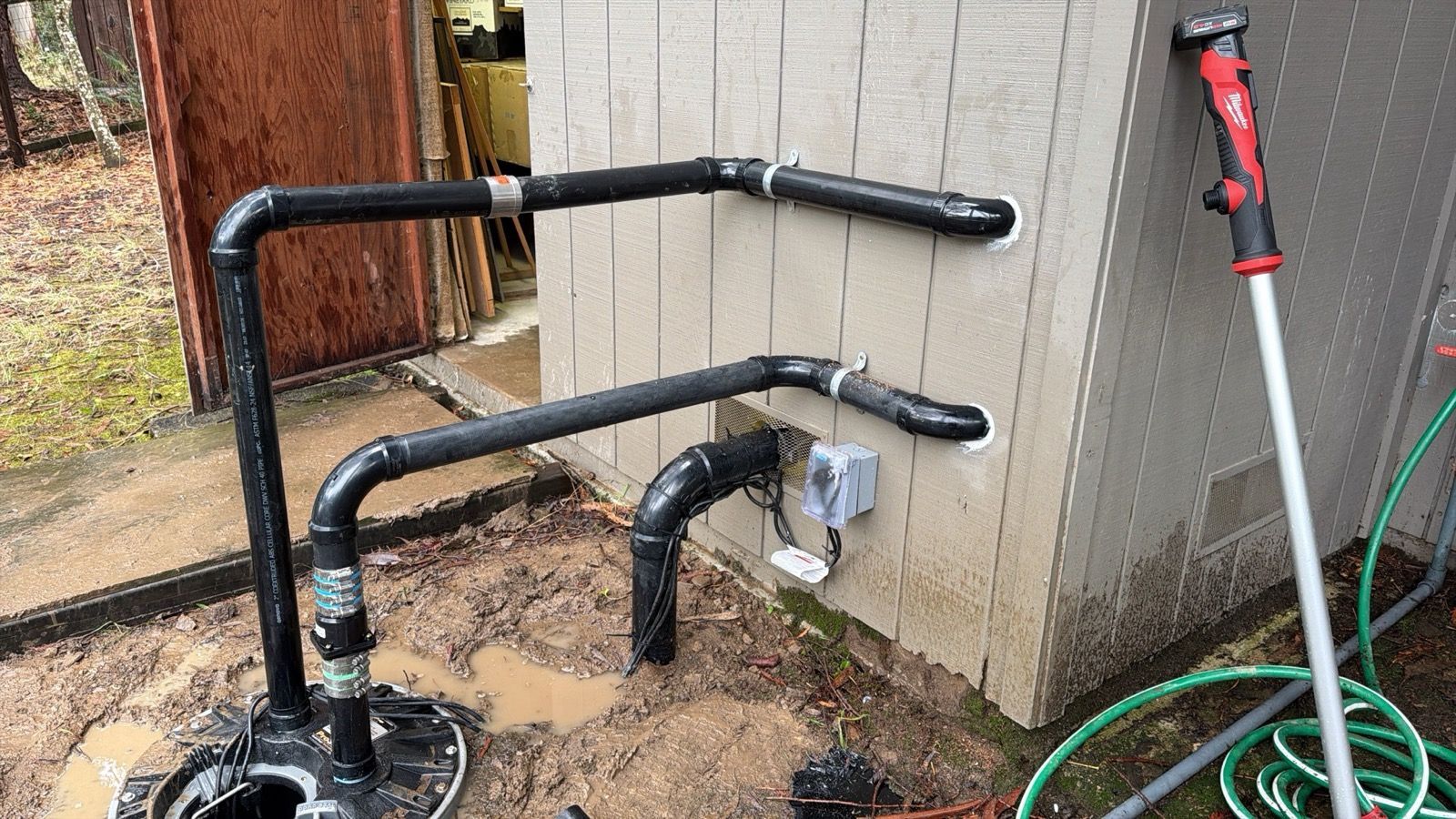
A different Mill Valley home had a sewage ejector pump under the house. An ejector lifts wastewater from fixtures below the sewer line (a lower bathroom or laundry) up to the main line. Servicing one in a crawl space is unpleasant, and a failure there means sewage under the house.
The homeowner supplied a new Liberty Pumps ejector, and we moved the whole system outside:
- Rerouted the drainage outside in new ABS pipe, with good fall to the new location.
- Excavated and set a new in-ground basin outdoors.
- Installed the pump with a check valve and an isolation ball valve, so it can be serviced without draining the line back.
- Removed the old basin and pump from under the house and capped the old connection.
- Tested it through multiple cycles.
Now the pump is easy to reach, and if it ever needs service, the work happens outside, not in the crawl space.
Why Mill Valley Crawl Spaces Get Wet
- Hillsides. Water moves downhill underground, and a house cut into a slope is often in its path.
- Heavy winter rain. Storms here can drop several inches in a day, and the ground stays saturated for weeks.
- Older foundations. Many Mill Valley homes were built on raised foundations with dirt crawl spaces and no drainage plan.
- Downspouts that dump at the foundation. Roof water that lands next to the house often ends up under it.
Before the Next Storm
- Look under the house after a big rain. Standing water, wet soil or a musty smell are the signs.
- Test your sump pump. Pour a bucket of water into the basin and make sure the pump starts and stops.
- Check the discharge. Make sure it isn't clogged, crushed or draining back toward the house.
- Listen to your ejector. An ejector that runs constantly, cycles a lot or sets off its alarm needs a look.
- Know your power plan. Pumps stop when the power goes out, which in a storm is often when you need them most. Ask us about battery backup or a plug-in option for a generator.
What It Costs
Sump and ejector work is priced after we see the site, because access, pit depth and the length of the discharge run drive the cost. A pump-only replacement in an existing basin costs much less than a new pit and basin in a crawl space, and relocating an ejector outdoors is a bigger project than swapping a pump in place. Every estimate is free and in writing before work starts. See our sewage ejector pump page.
Mill Valley Sump Pump FAQs
Do I need a sump pump if water only shows up in big storms?
Often, yes. Even a few days of standing water each winter can rot framing and feed mold. A pump in a basin at the low point keeps it from building up.
What's the difference between a sump pump and an ejector pump?
A sump pump moves groundwater or rainwater. An ejector pump moves sewage from fixtures below the sewer line. They aren't interchangeable.
How long does a sump pump last?
Many last around 7 to 10 years, depending on how often they run. Test yours every fall.
Can a sewage ejector be moved outside?
Often, yes, if there's room for a basin and the drainage can be rerouted with the right fall. It makes future service much easier.
Sump and Ejector Pumps Across Mill Valley
We install and repair sump and ejector pumps across Mill Valley, from Cascade Canyon and the Old Mill area to Homestead Valley, Strawberry and Tamalpais Valley, from our shop in San Rafael. Licensed C-16 & C-36, Lic #1091739. Call or text (415) 234-0370 or contact us. More on our Mill Valley plumbing services, and see our Tiburon sump pump post for more storm prep.