Sump Pump Installation & Repair in Marin & Sonoma
Open 24/7, emergency service available · new pumps, replacement pumps & backup systems · written price before any work starts
Water collecting under the house, in a yard drain or on a lower floor every time it storms? We install, repair and replace sump pumps that move groundwater and rainwater away from your home: crawl-space basins, yard and side-yard catch basins, and the occasional basement pit. Since March we’ve installed or replaced sump pumps in Tiburon, Larkspur, Mill Valley, Belvedere, Kentfield and Santa Rosa, five of them since the start of October.
Water rising right now? Call or text instead of booking online.
From our San Rafael shop & training facility · Emergency plumbing · Contact us
Pump quit in a storm? Call or text (415) 234-0370. Tell us where the pit is and whether the pump hums, runs nonstop or does nothing.
Test your sump pump before the next storm
Most sump pumps sit idle all summer, so the first heavy rain is often the first time anyone learns the pump has died. These five checks take about ten minutes.
-
Power
Confirm the pump is plugged in and the outlet is live. If it’s a GFCI outlet, press reset. Some Zoeller pumps we install come with a lighted plug, so a glance tells you whether power is reaching the cord.
-
The bucket test
Pour a five-gallon bucket of water slowly into the pit. The float should lift and the pump should kick on, drain the pit down and switch itself off. If nothing happens, or it hums without moving water, stop and call.
-
The shut-off sound
A hard thump when the pump stops, followed by water sliding back into the pit, usually means the check valve on the discharge pipe has failed. The pump then re-pumps the same water over and over.
-
The float’s path
Look for anything that could pin the float: the cord, a loose piece of pipe, silt or gravel in the bottom of the pit. A trapped float is one of the most common reasons a healthy pump never starts.
-
The outlet outside
Follow the discharge pipe to where it ends. It should be open, clear of leaves and soil, and sending water away from the house rather than back toward the foundation or across a walkway.
Want a second pair of eyes? We do sump inspections too: a full test cycle, a look at the float, basin and discharge piping, and written findings. Storm-prep notes for peninsula homes are in our Tiburon sump pump post.
Repair or replace?
Plenty of “dead” sump pumps turn out to have a stuck float or a bad valve. Others are simply worn out. Here’s how we usually decide.
Usually a repair
- A float stuck on the cord, the basin wall or debris
- A failed float switch on a pump that otherwise runs strong
- A check valve that slams or lets water drain back
- A cracked or loose joint on the discharge pipe
- Silt and gravel packed into the bottom of the pit
- A clogged intake screen
Usually a replacement
- The motor hums but the impeller won’t turn (seized)
- The pump trips the breaker or GFCI every time it starts
- Heavy rust on the pump body or cord entry
- The pump is undersized and can’t keep up in a long storm
- Nobody knows how old it is, and it’s the only thing keeping the crawl space dry
- The basin itself is cracked or the pit keeps filling with mud
Recent sump pump jobs in Marin & Sonoma
Taken from our job history with anything identifying left out: where, when, what had failed and what went in.
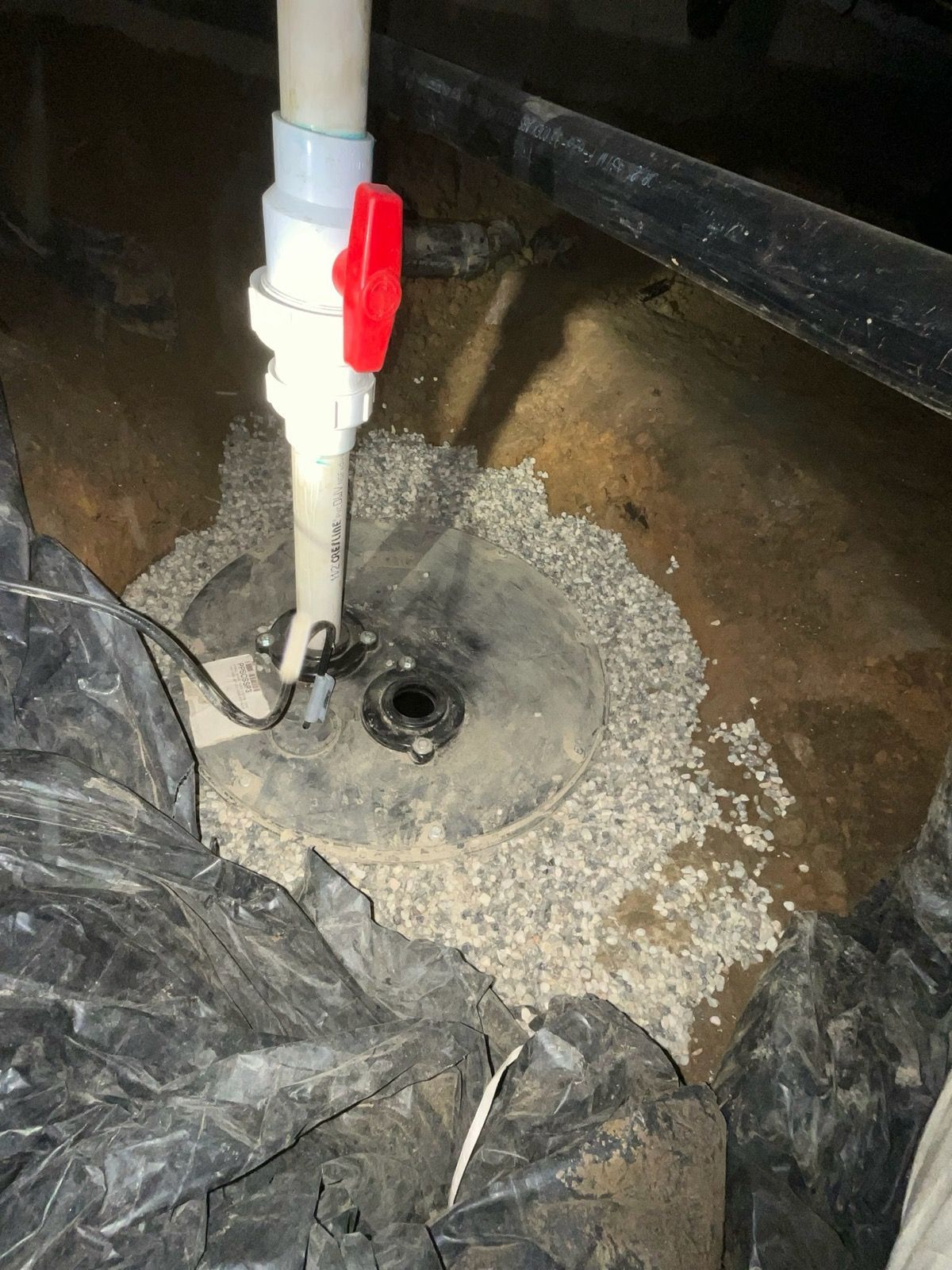
A crawl space with nowhere for the water to go
Groundwater was pooling under the house after every rain. We dug down at the low point of the crawl space and set a perforated basin, then backfilled around it with gravel so water seeps in through the sides while the gravel holds back the soil. Inside went a Little Giant 1/3 HP pump. A 1-1/2″ PVC discharge line runs across the crawl space, strapped along the way, and out through the exterior wall. Before cutting the line to length we went over the exit point with the homeowner, whose main worry was water pooling on the sidewalk. We cycled the pump about five times before leaving.
Two yard basins, two new pumps
Two homes, two in-ground basins that collect yard and side-yard drainage under a grate. One pump had stopped working entirely.
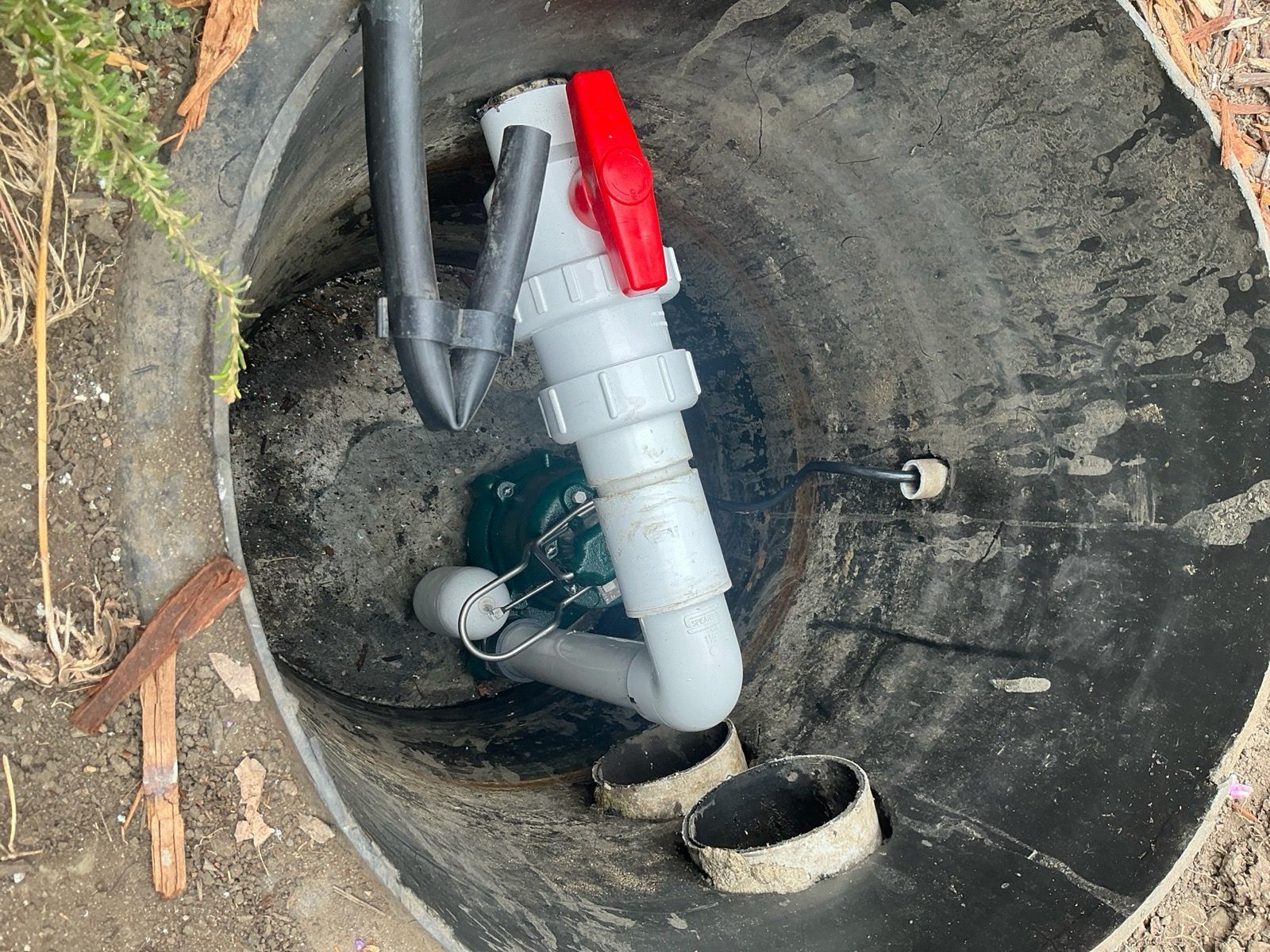
We installed a 1/2 HP Zoeller Flow-Mate M98 in each, re-piped the discharge with a new swing check valve, and on one added a shutoff valve on a union so the pump can come out without cutting pipe. Each ran through a full cycle before we left.
Pump only, existing basin
The basin was sound, but the pump was done and the pit was full of corrosion and debris.
We cleaned the basin out, set a new Zoeller M98 on the existing base, and reconnected it with a new check valve. Reusing a good basin keeps the job to one visit.
A new pump and a new discharge run
A sump needed a reliable pump and a discharge line that would actually carry the water away.
We installed a Zoeller M98, ran new 2″ PVC discharge with a swing check valve, and tested it full to empty. Santa Rosa storm-prep tips are in our Santa Rosa sump pump post.
Also this past year: a straight swap to a Zoeller M53 connected to existing piping on the Tiburon–Belvedere peninsula (December 2025), and a crawl-space sump inspection and test with written findings in Tiburon (November 2026).
Water under the house? We’re open 24/7.
Bigger systems: groundwater catch basins
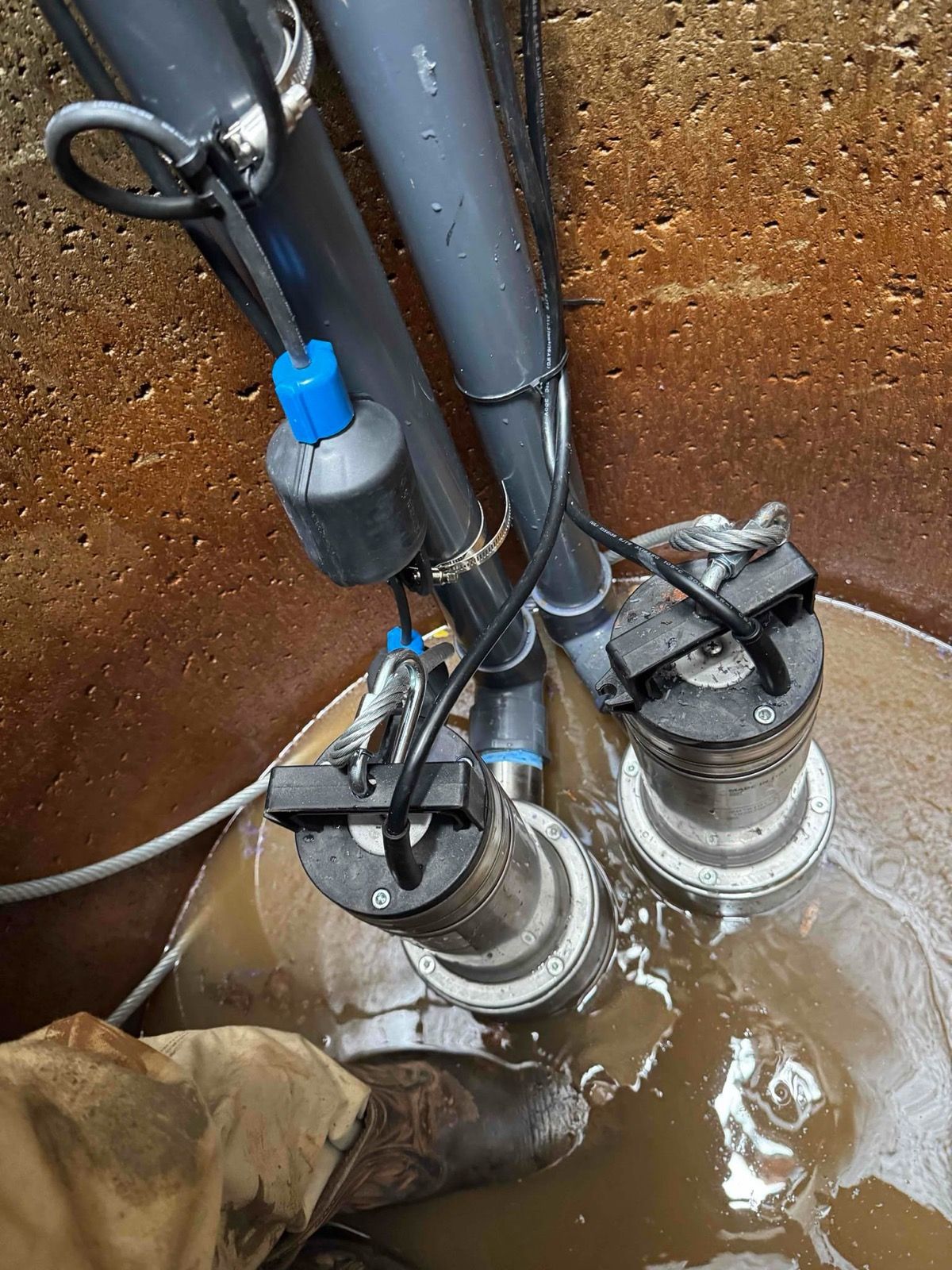
Some hillside and waterfront properties don’t have a small pit with one pump. They have a deep concrete catch basin collecting groundwater from drains around the house, with two pumps, several floats and a control panel deciding which pump runs. These systems need a different approach.
- Belvedere, May 2026. Two heavily rusted pumps in a deep groundwater basin. We disconnected the piping, pulled both pumps, cleaned the dirt and debris out of the bottom, and set two new stainless steel submersible pumps with weep holes and check valves, new floats and a new control panel. We glued the pipe connections, tested each pump and float, and added a pulley system so the next service doesn’t mean lifting a pump out by hand.
- Kentfield, March 2026. A gravel-set basin beside a crawl space. We matched a new pump to the existing specs, cleaned out the pit, installed it with a weep hole and check valve, reconnected the discharge with a band coupling and ran it through its cycle.
- What a weep hole does. It’s a small hole drilled in the discharge pipe between the pump and the check valve. It lets trapped air escape so the pump doesn’t spin without moving water.
Multi-pump systems are priced after we see them. If your system also lifts sewage from a lower bathroom, that’s an ejector, covered below.
Backup pumps, alarms and power outages
Storms knock out power, and an ordinary sump pump stops the moment the power does. If water under or inside the house would do real damage, plan for that night now.
- Battery backup pump. A second pump in the same pit, wired to a battery and charger. It takes over when the main pump fails or the power goes out. It runs for a limited time, so the battery needs checking and eventually replacing.
- Water-powered backup pump. Uses the pressure in your city water line, not electricity, to pull water out of the pit. It keeps running through a long outage, but it uses household water while it runs and needs a backflow preventer so pit water can never be drawn into your drinking water. It only works on a municipal supply with decent pressure.
- High-water alarm. A float in the pit that sounds an alarm when the water climbs above where the pump should have started. Some models also send an alert to your phone. Cheap insurance for a crawl space nobody looks into.
- Generator plan. A plug-in pump can run from a properly sized generator. We’ll tell you what the pump draws. New outlets or circuits are electrician work, and we say so up front.
Where the water goes: discharge placement
A sump pump is only as good as the place it sends the water. In a big storm a pump can move a lot of water, and if it lands in the wrong spot it walks straight back toward the house.
What we aim for
- An outlet well away from the foundation, on ground that falls away from the house
- A spot that won’t pool on a walkway, driveway or sidewalk
- A route that keeps water off the neighbor’s property
- Pipe strapped and supported along its whole run
- A check valve, plus a shutoff on a union where there’s room
What we fix
- Discharge dumping right beside the foundation
- A line buried, crushed or packed with leaves at the end
- Undersized or sagging pipe that holds water
- Groundwater piped into a sewer cleanout or drain
- No check valve at all
We agree the exit point with you before we cut the pipe to length. Moving it later means another visit.
Sump pump or ejector pump?
They look alike in a pit, but they do different jobs. A sump pump moves clear groundwater and rainwater out of a crawl space, yard basin or basement. A sewage ejector lifts wastewater from a toilet, shower or laundry that sits below the sewer line, in a sealed, vented basin. They aren’t interchangeable, and a sump pump should never be used for sewage. If your pit takes water from a lower bathroom or laundry, see our ejector pump page.
What sump pump work costs
The biggest price drivers are whether the basin can be reused, how hard the pit is to reach, and how long the discharge run is.
Typical ranges from our recent jobs. Every site is different, and you get the exact price in writing before work starts.
Sump pump FAQ
Do you do emergency sump pump repair?
Yes. We’re open 24/7 and emergency service is available across Marin and Sonoma. Call or text (415) 234-0370 and tell us where the pit is and what the pump is doing.
Why does my sump pump hum but not pump water?
Usually a jammed or seized impeller, a failing motor, or an air-locked discharge. If it’s been humming for a while, unplug it so the motor doesn’t burn out, and call.
Why does my sump pump keep turning on and off?
Short-cycling usually points to a failed check valve letting water fall back into the pit, a float set too tight, or a pit that’s too small for the inflow. All three are fixable.
How long do sump pumps last?
Commonly 7–10 years, less if the pump runs a lot. Pumps in crawl spaces and yard basins often go years without anyone looking at them, so test yours every fall.
Do I need a battery backup sump pump?
If an outage during a storm would leave water in a finished space or under the house for hours, yes. A battery backup or a water-powered backup keeps the pit drained when the main pump can’t.
Can you replace just the pump and keep my basin?
Often, yes, if the basin is intact. We clean it out, set the new pump and reconnect the discharge with a new check valve. That’s the simplest and least expensive kind of sump job.
Where should my sump pump discharge?
Away from the foundation, onto ground that drains, and not onto a sidewalk or a neighbor’s yard. Never into the sewer. We plan the exit point with you before we finish the pipe.
How much does sump pump installation cost?
A pump swap in an existing basin costs much less than a new basin with a long discharge run, and big catch-basin systems are priced on site. You get a written price before we start.
Marin: Sausalito, Mill Valley, Tiburon, Belvedere, Corte Madera, Larkspur, Greenbrae, Kentfield, Ross, San Anselmo, Fairfax, San Rafael, Terra Linda, Lucas Valley and Novato. Sonoma: Petaluma, Penngrove, Cotati, Rohnert Park, Sonoma, Glen Ellen and Santa Rosa. Local pages: Tiburon · Mill Valley · Belvedere. More: ejector pumps · emergency plumbing · contact us.
Sump pump failing, or not sure it will start?
Call or text and tell us what you see in the pit. We’ll test it, fix it or replace it, and give you the price in writing first.