
Eichler Radiant Heat Repair in Terra Linda & Lucas Valley
Boiler keeps losing pressure? A spot on the floor stays warm all year? Water bill creeping up with no sign of a leak? The radiant tubing in your slab is the first thing to check. We do the testing before anyone talks about cutting concrete.
Pick a time online. We'll confirm your visit. Pressure dropping right now? Call or text.
Marin's Eichler neighborhoods, and why the build year matters
Marin has about 1,600 Eichlers, and most of them are in north San Rafael and Lucas Valley–Marinwood. Every one was built on a concrete slab with hydronic tubing poured inside it. The heat is only as good as that tubing.
Local Plumbing repairs Eichler radiant heat across Terra Linda, Marinwood and Lucas Valley. We work out of our San Rafael warehouse a few miles down 101. For the background on why Eichler radiant pipes fail, see our guide, Radiant Heating Piping Leaks in Eichler Homes in San Rafael. This page covers what we find in these neighborhoods, how we diagnose it, and your options once a loop fails.
What's in your slab depends on when your tract was built. Eichler's earliest homes used copper. During the Korean War copper shortage he switched to steel, and most Eichlers built before about 1958 have steel radiant pipe, while later homes generally have copper. Here's how that lines up locally:
Terra Linda (South and North)
Built 1955–1961, with some later.
Likely tubing: steel in the earlier tracts, copper in the later ones. Terra Linda is part of the City of San Rafael.
Marinwood / lower Lucas Valley
Built mostly 1957–1958.
Likely tubing: right on the changeover, so it could be either. Unincorporated Marin County.
Upper Lucas Valley
The "mountain" streets: Mt. Shasta, Mt. Whitney and the rest. Built 1962–1966.
Likely tubing: copper. Unincorporated Marin County, with its own homeowners association review for exterior changes.
Sleepy Hollow & Strawberry Point
Smaller Eichler tracts in Sleepy Hollow (San Anselmo) and Strawberry Point (Mill Valley). Build years vary.
Likely tubing: check house by house.
The tubing column is a pattern, not a rule. We confirm the material at the manifold or at an exposed pipe before we recommend anything.
Copper tubing
- A pinhole can usually be located and repaired or bypassed
- The rest of the loop can keep working for years
- With one or two leaks, fixing it is usually worth it
Steel tubing
- Tends to corrode from the inside once fresh, oxygenated water keeps getting added
- The first leak in a steel loop is often the start of more
- With repeated leaks, it's often time to abandon or replace the affected loops rather than keep patching
Copper and steel fail differently. We'll tell you which one you have and what that means before you spend money.
Signs your radiant slab has a problem
Most slab leaks never show on the floor. The water usually goes straight down into the soil under the slab. So the clues are almost always at the boiler, the thermostat or the water meter.
Boiler pressure keeps dropping
Someone "tops it off" every few weeks. Usually: a leak somewhere in the closed loop, which could be slab tubing, a weeping relief valve or a rusted-out expansion tank.
We check the relief valve, expansion tank and fittings first (the cheap causes), then pressure-test loop by loop.
A warm spot on the floor that doesn't move
Even with the heat off. Usually: hot water escaping from a tube under that spot.
We use thermal imaging to trace the tube, then isolate that loop.
Water bill up, nothing dripping
Usually: fresh water feeding a slab leak through the auto-fill valve.
We shut the fill valve and watch the pressure. If it falls, the leak is in the heating side.
Boiler short-cycling or running constantly
Usually: air in the loops, a failed circulator, an oversized replacement boiler, or water loss.
We check flow, air, pump and boiler settings before blaming the slab.
One room or zone always cold
Usually: a stuck zone valve, an airlocked loop, or a loop someone already shut off years ago.
We run a loop-by-loop temperature and flow check at the manifold.
Not always the slab
A falling gauge doesn't always mean a slab leak. Sometimes the "slab leak" is a relief valve or an expansion tank.
We test the cheapest cause first.
Pressure dropping or a warm spot on the floor?
How we find the leak without breaking the floor
Testing first, concrete last: we find the leaking loop before any concrete is cut.
-
System check
Boiler pressure cold and hot, expansion tank charge, relief valve, auto-fill valve, air separator, circulator.
-
Isolate the heating side
Close the fill valve and watch the gauge. A closed system shouldn't lose pressure.
-
Loop-by-loop pressure test
Each radiant loop is valved off and tested on its own. That tells us which loop leaks, which is usually enough to decide the repair.
-
Thermal imaging
With hot water running through the suspect loop, the tubing shows up through the floor on a thermal camera. We use it to trace where the loop runs and to spot the heat bloom over a leak.
-
Pinpoint only if it's worth it
If the plan is to bypass the loop, we don't need the exact pinhole. If a single spot repair makes sense (usually copper), we narrow it down before any concrete is cut.
-
Written finding
You get a written finding before any repair, with the options that fit your pipe, your floors and your plans.
Published pricing. Detection depends on the number of loops and how accessible the manifold is; a repipe depends on how many loops and how much floor is involved. More on leak detection.
Your options once a loop fails
The right answer depends on pipe material, how many loops have failed, your floors, and how long you'll stay.
Repair the leak
If one pinhole is found in otherwise sound copper, we can open a small section of slab, repair it, and put the loop back in service.
Isolate and abandon the loop
Fine for a closet or hallway, not a living room.
Reroute the loop
Run new PEX to replace a failed loop through a wall, a cabinet toe-kick or a new floor section.
Wall panels or a new radiant floor
Eichlers have open-beam ceilings and no attic, so there's nowhere to hide ceiling panels or ductwork. The realistic alternatives are wall-mounted panel radiators fed by the same boiler, or a new low-profile radiant floor laid over the old slab during a flooring project. Once too many loops have failed, especially in steel, re-doing the house this way is usually cheaper than chasing leaks one at a time.
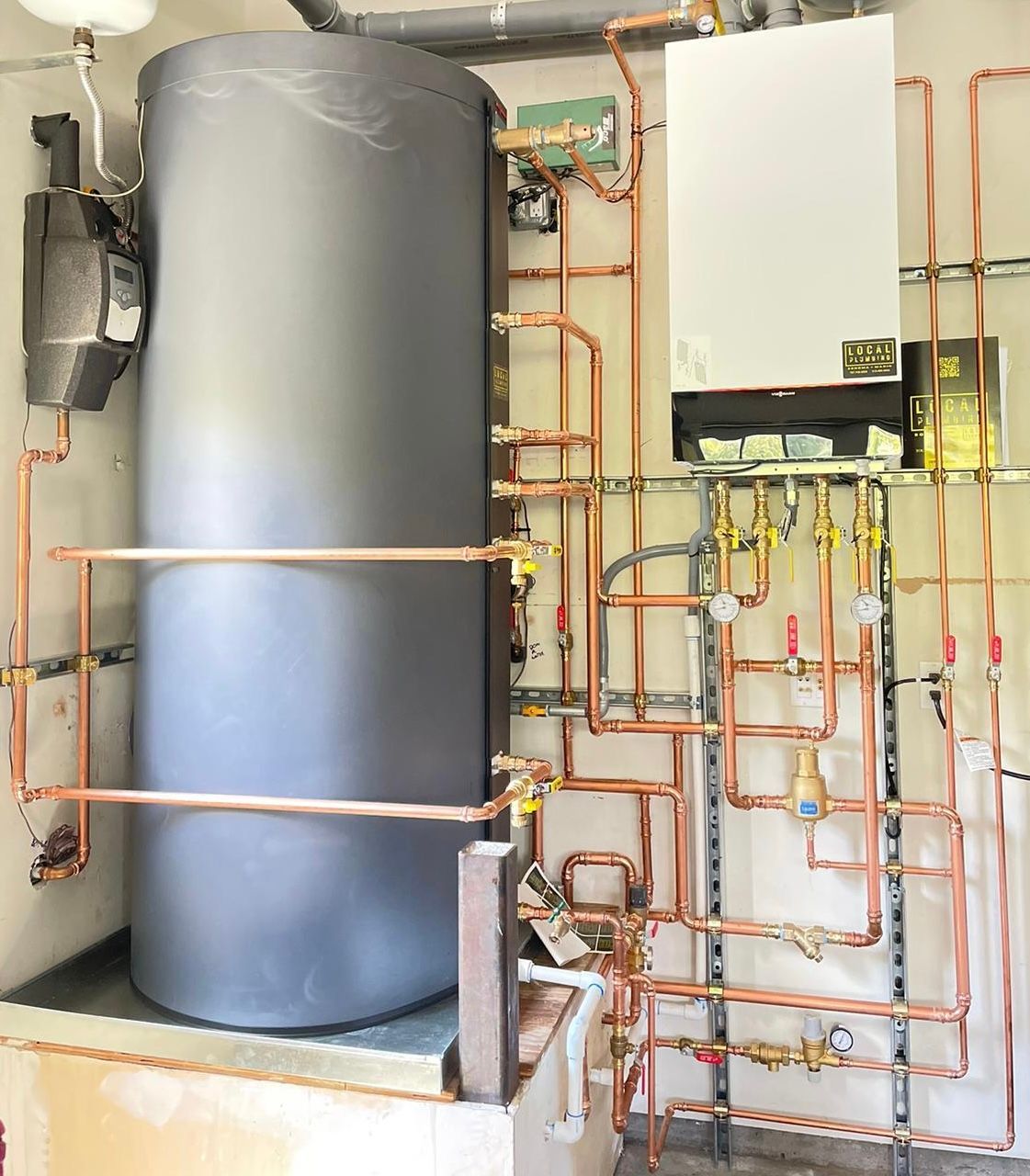
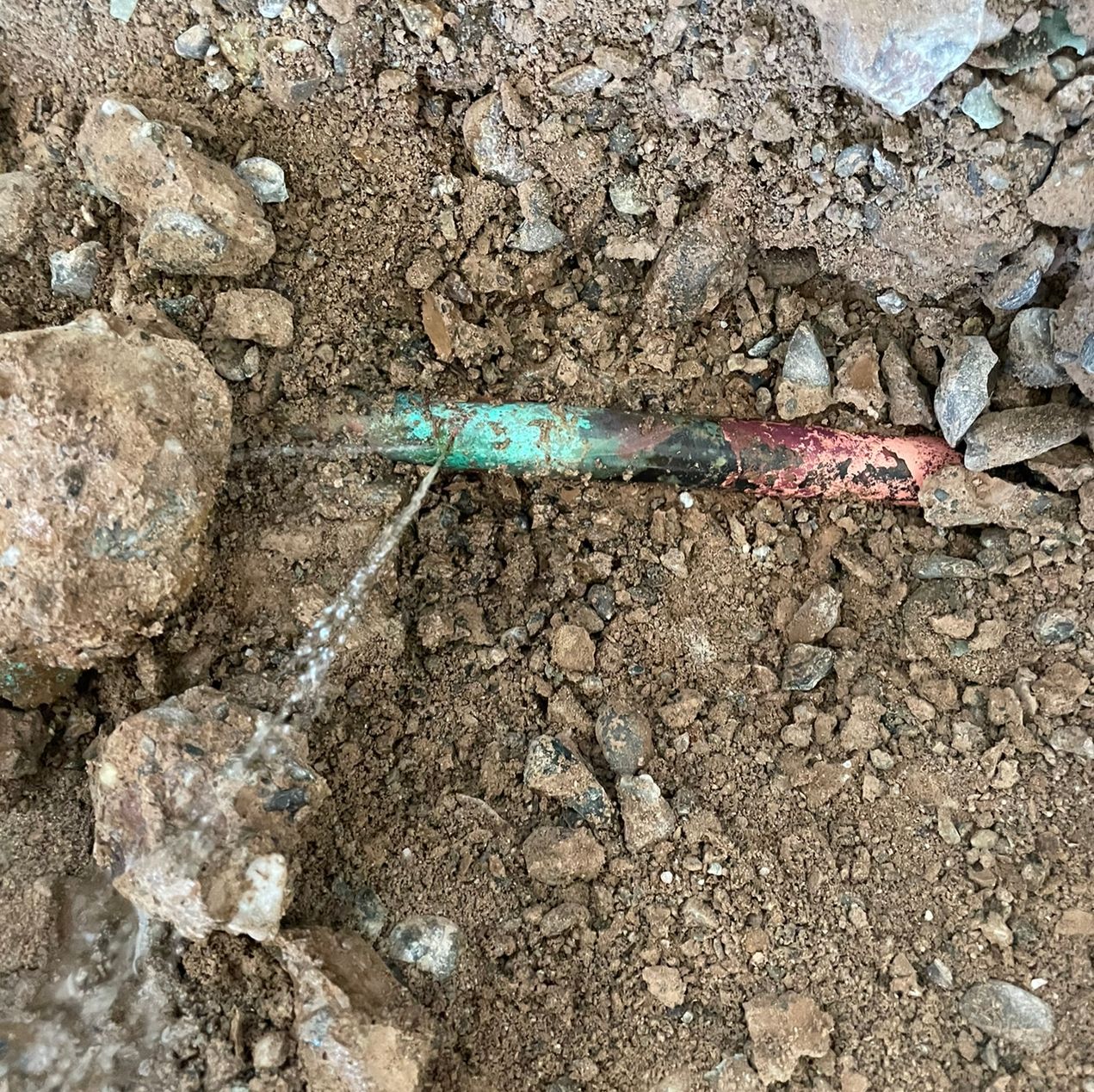
Pinhole leak under the slab, fixed with a new above-slab radiant run
A pinhole leak in a radiant loop beneath the slab. We isolated the failed loop and installed a new radiant run above the slab.
Replacing the boiler in an Eichler
Many Eichler boilers sit in a utility closet or the garage, often with a water heater beside them. When the slab is still sound but the boiler is old, a modern condensing boiler is a good match: radiant slabs run on low water temperatures, and that's where a condensing boiler is most efficient.
What we get right on Eichler replacements
- Size to the house, not the old boiler. Older Eichler boilers are often oversized for a well-behaved slab, and an oversized modern boiler short-cycles.
- Outdoor reset. An outdoor sensor lets the boiler send cooler water on mild days and hotter water on cold nights. A slab is slow to respond, so this keeps the house even instead of overshooting.
- Protect the slab. A mixing valve or a properly set low-temperature curve keeps supply water in the range the slab and your floor finish can handle.
- Separate the old loops. Where steel loops remain, we often use a plate heat exchanger or careful air and dirt separation so rust from the old pipe doesn't foul a new boiler's heat exchanger.
- Combi or indirect. A combi boiler such as a Navien NFC can also replace the water heater and free up space in the closet.
Typical published ranges. Venting, gas sizing and piping move the number. See boiler replacement.
Still have a Triangle Tube?
Parts and warranty support ended when the company shut down in November 2025. Read our Triangle Tube shutdown guide.
Air-to-water heat pumps for your slab
Because a slab runs on low water temperatures, it's one of the best matches for an air-to-water heat pump, which heats water with an outdoor unit instead of burning gas. We install air-to-water heat pumps for radiant systems. Ask us whether your house is a candidate. In Upper Lucas Valley, outdoor equipment and new exterior vents also go through the Lucas Valley Homeowners Association's Architectural Review Committee, so we plan for that up front.
Permits, sewer rules and air-district rules here
City or County?
Terra Linda voted to annex to the City of San Rafael in the early 1970s, so boiler and repiping permits there go through the City of San Rafael Building Division. Lucas Valley–Marinwood is unincorporated, so those permits go through the County of Marin Community Development Agency. Sleepy Hollow and Strawberry are also County. We pull the permit either way.
Las Gallinas Valley Sanitary District
Terra Linda, Marinwood and Lucas Valley are served by LGVSD, which requires a sewer lateral inspection when a home is sold or when you have a building permit of $30,000 or more. A whole-house radiant conversion can cross that line. We don't do lateral work, but we'll flag it early and can refer you.
Soft Marin Water
Marin Water supplies these neighborhoods with soft water, so if your steel loops are failing, it's corrosion from oxygen and age, not hard water. That's also why we don't want anyone topping off a leaking system for years.
BAAQMD Rule 9-6
The Bay Area Air District's zero-NOx rule covers gas boilers. It applies when equipment is sold or installed, so your existing boiler can keep running.
Is gas being banned for boilers?
Not yet. Under the Bay Area Air District's Rule 9-6, the zero-NOx requirement for home-sized gas boilers applies to units manufactured after January 1, 2031 under the current rule (a July 2026 draft amendment would push that to 2033). Existing boilers can keep running, and new gas boilers can still be installed today. We'll tell you where the rule stands when you're deciding.
What our customers say
Rated 5.0 on Google across our San Rafael and Sausalito locations (340+ reviews). A few from heating customers:
“The pump for my radiant heating went out in the middle of winter… Local Plumbing came right away… got the job done that day, on time, on budget and very professional.”Jeff S. · Local Plumbing customer
“Had to replace a failing gas/solar/radiant/domestic do everything 120 gal hot water tank. The job was complicated and a couple plumbers didn't even submit bids. You want Local Plumbing because they know all things radiant.”Naomi K. · Local Plumbing customer
“They helped us with a client that had issues with a defective radiant heat and hot water system. They were extremely kind and professional with our client who was raving about the work they did.”Alana C. · Local Plumbing customer
Why Eichler owners call Local Plumbing
- Hydronic and radiant specialists. Licensed C-16 & C-36 contractor (Lic #1091739).
- Dozens of Eichler loop bypasses, plus leak detection, thermal imaging, pressure testing, loop isolation and above-slab repiping.
- Combustion analysis on every boiler service, not just a visual check.
- Local. Our warehouse and training facility is in San Rafael, a few miles down 101.
- Award-recognized. Owner Conor Crawford received the PHCC California Young Entrepreneur of the Year award in 2026.
- Written estimate before any work starts.
Eichler radiant heat FAQ
How do I know if my Eichler radiant heat is leaking?
Watch the boiler pressure gauge. If it keeps dropping, or someone has to add water every few weeks, the closed loop is losing water somewhere. A water bill that rises with nothing dripping, or a floor spot that stays warm with the heat off, point the same way.
Can Eichler radiant slab leaks be repaired without jackhammering the floor?
Usually. We find which loop leaks by pressure-testing each one at the manifold, then trace it with thermal imaging. Most fixes are bypassing or rerouting that loop above the slab, not breaking up the floor.
Do Terra Linda Eichlers have steel or copper radiant pipes?
Many earlier Terra Linda Eichlers (mid-1950s) have steel. Later tracts, and Upper Lucas Valley (built 1962–66), generally have copper. We confirm it at your manifold before recommending a repair.
Is it worth fixing original Eichler radiant heat?
With copper and one or two leaks, usually yes. With steel and repeated leaks, it's often time to abandon or replace the affected loops rather than keep patching.
How much does Eichler radiant repair cost?
Our published pricing: slab leak detection and isolation $650–$1,800, a full Eichler radiant loop repipe $3,500–$9,500. A radiant boiler replacement is typically $12,000–$18,000. Every job gets a written estimate.
Do I need a permit for a boiler in Lucas Valley or Marinwood?
Yes. Lucas Valley and Marinwood are unincorporated, so the permit comes from the County of Marin, not the City of San Rafael. Terra Linda is City. We handle either.
We cover Terra Linda, Marinwood, Lucas Valley and Upper Lucas Valley, Santa Venetia, Sleepy Hollow, Strawberry and the rest of San Rafael. For radiant problems outside an Eichler, see radiant heating repairs and our Marin & Sonoma radiant repair guide. For a new boiler, see boiler replacement and our boilers & radiant page.
Pressure dropping or a warm spot on the floor?
Book a visit online, or call or text us. We'll test the slab before anyone talks about concrete.